
How Often Should Rowers Train Their Core?

Rowing already places high demands on the core. Every stroke transfers force from the legs, through the body, and into the handle, repeated hundreds or thousands of times per session.
Many rowers include additional core work to improve strength and stability. Done well, this supports performance. Too much, however, can create fatigue and soreness that undermine performance. So what’s the sweet spot?
Why Core Training Matters for Rowers
In rowing, the role of the core is often misunderstood.
The primary job of the core is to resist unwanted movement so that power can be transferred efficiently:
Anti-extension: resisting excessive arching as force is applied
Anti-rotation and lateral stability: resisting twist and side bend to stay square under load
Endurance: maintaining position as fatigue rises, when technique is most likely to break down
This matters because lower back pain is common in rowing populations. Research highlighted by World Rowing suggests that around 30–50% of rowers experience an episode of lower back pain over a 12-month period.
Maintaining position under load is a key part of reducing this risk. As spine researcher Stuart McGill has noted: “Those with endurable core strength could maintain good form and had fewer disabling back injuries.”
Core work won’t guarantee you avoid issues, but well-structured core training is one of the more controllable factors in supporting both performance and resilience.
Why Too Much Core Work Can Undermine Your Rowing
In many cases, rowers are already training their core hard through strength work. Squats, deadlifts, and pull-ups all require strong bracing and control. The goal of additional core work should be to target the specific stability demands of rowing, but it's easy to overdo it.
Fatigue is one of the main drivers of technical breakdown in rowing, particularly during longer or more intense sessions. When the core is fatigued or still sore from previous training, it becomes much harder to maintain position and transfer force effectively.
As intensity increases, particularly during hard intervals or race preparation, this often shows up as:
Collapsing at the front end
Overreaching and overloading the lower back
Early layback or loss of sequencing
Twisting through the finish
These are not just technical errors; they are often signs that the core is no longer able to do its job effectively under fatigue. This is why simply adding more core work isn’t automatically better.
How Often Should Rowers Train Their Core?
For most rowers, 2 focused core sessions per week are enough to improve strength, stability, and control, provided the work is well targeted and executed well.
If core work starts to create fatigue or soreness that affects your rowing, it is likely doing more harm than good.
Core training should make your rowing feel more stable, not more tired.
When Should You Do Core Training?
The core plays a key role in maintaining position and transferring force during both rowing and strength training. If it is fatigued beforehand, it becomes much harder to hold good technique and produce force effectively.
For this reason, core training should be done after rowing or at the end of a strength session, so it does not compromise the quality of your main work.
My Favourite Core Exercises for Rowers
1) Plank

Why it matters:
Helps you hold position so force transfers cleanly from the legs into the handle.
Focus:
Ribs down, glutes lightly engaged, no sagging or flaring.
2) Side Plank

Why it matters:
Helps you stay symmetrical and avoid collapsing to one side, especially as fatigue increases.
Focus:
Stay long through the body. Don’t let the hips drop or rotate.
3) Pallof Press
Can be performed with a resistance band or cable machine

Why it matters:
Helps you resist rotation and stay square under load for more consistent force.
Focus:
Tall posture, controlled press, don’t let the band or cable pull you out of position.
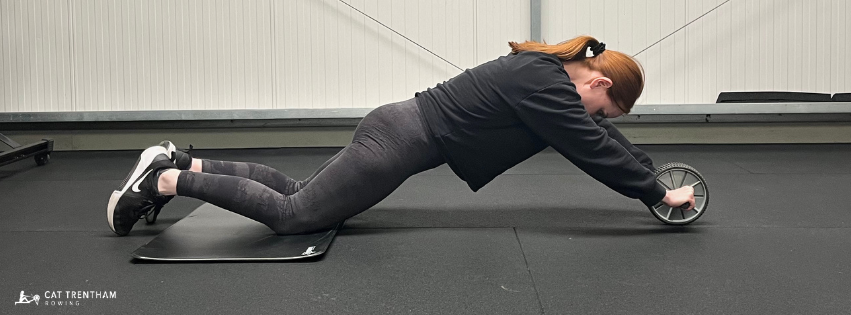
4 Rollouts
Why it matters:
A progression from the plank, rollouts challenge you to maintain position as the movement becomes more demanding.
Focus:
Only roll out as far as you can maintain a strong spinal position.
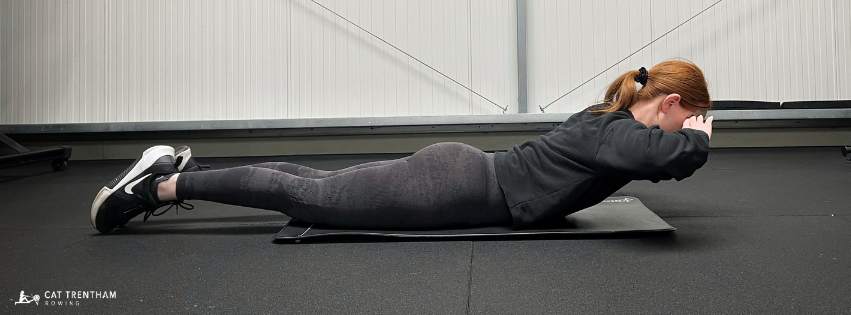
5) Back Extension
Why it matters:
Builds posterior chain endurance to support repeated hip hinging and maintain posture.
Focus:
Move through the hips, not the lower back. Avoid overextending at the top.
6) Suitcase Carry

Why it matters:
Builds bracing and lateral stability under load, helping you stay controlled and symmetrical.
Focus:
Stay tall, no leaning, controlled steps.
A Simple Two-Session Core Structure
A simple two-session structure is enough for most rowers.
Aim to spread these sessions evenly across the week to allow for recovery, for example on Monday/Thursday or Tuesday/Friday.
Session A
Plank 3 x 30–60 seconds
Pallof Press 3 x 8–12 per side
Back Extensions 3 x 10
Session B
Side Plank 2 x 30–60 seconds per side
Rollouts 3 x 5–10 (once you can hold a strong plank)
Suitcase Carry 4 x 20–40 metres (2 per side)
How to Progress Core Training
Progress core work by making it more challenging, not by simply doing more.
This can be done by:
Increasing tension or load (e.g. more weight or a heavier band)
Increasing reps or duration towards the higher end of the target range
Slightly reducing rest between sets, while maintaining quality
Avoid adding reps if position breaks down.
If your rowing quality starts to suffer or you feel residual fatigue affecting key sessions, reduce volume. Then rebuild when ready.
A Better Approach to Core Training
Core training should refine control, not simply add more work. It should help you maintain position as fatigue rises and intensity increases.
For most rowers, two focused sessions each week is enough. Beyond that, you’re often adding fatigue rather than capacity.
Keep it measured, structured, and purposeful.
If you enjoyed reading this article and would like to be notified about new articles and training insights, you can sign up to my free monthly newsletter.


