
How to Balance Rowing and Strength Training

How you fit strength training around your rowing can affect how well you perform in each. With both competing for space in your week, it isn't always obvious which sessions should go where or how much recovery you need between them. In this article, I'll explain how to structure your training so you can make progress in both.
Why Strength Training Helps Rowing Performance
Strength training can help you become stronger and more powerful, both of which can contribute to faster rowing. Research supports its benefits for rowing performance, including a 2020 review in the Journal of Sports Sciences. Former GB Rowing strength and conditioning coach Alex Wolf also describes strength training as a way to develop “fundamental rowing qualities”.
Why Session Order Matters
Hard rowing and strength sessions both cause fatigue, which can affect the quality of your next session. If you complete a heavy strength session before a hard rowing workout, residual fatigue can make it harder to produce your usual power, even the following day. Equally, I wouldn't recommend adding heavy strength work such as squats or deadlifts onto the end of a hard rowing session, as you'll already be fatigued before you start lifting.
This is why I don't look at each workout in isolation when I'm planning someone's training. Where a session sits within the week matters just as much as the session itself.
If rowing performance is your priority, I start by protecting your most important rowing sessions. For someone rowing three times per week, this would typically mean two harder sessions and one steadier aerobic row.
I usually leave at least a couple of days between the two harder rows and avoid placing heavy strength training immediately before them where possible.
The steadier row has an important role in building aerobic fitness without adding the same level of fatigue as a hard session. It also gives you more flexibility when arranging the rest of the week.
How Far Apart Should Strength Sessions Be?
For most rowers who strength train twice per week, I favour two full-body sessions rather than splitting muscle groups across separate days. This allows you to train the main muscle groups regularly without adding more strength days to your week.
The National Strength and Conditioning Association recommends completing full-body strength sessions on non-consecutive days.
Aim to leave around 48-72 hours between your strength sessions. How much recovery you need will depend on your training experience, how demanding your strength sessions are and what other training you're doing.
What Does a Balanced Training Week Look Like?
If you row three times and strength train twice per week, your training could look like this:
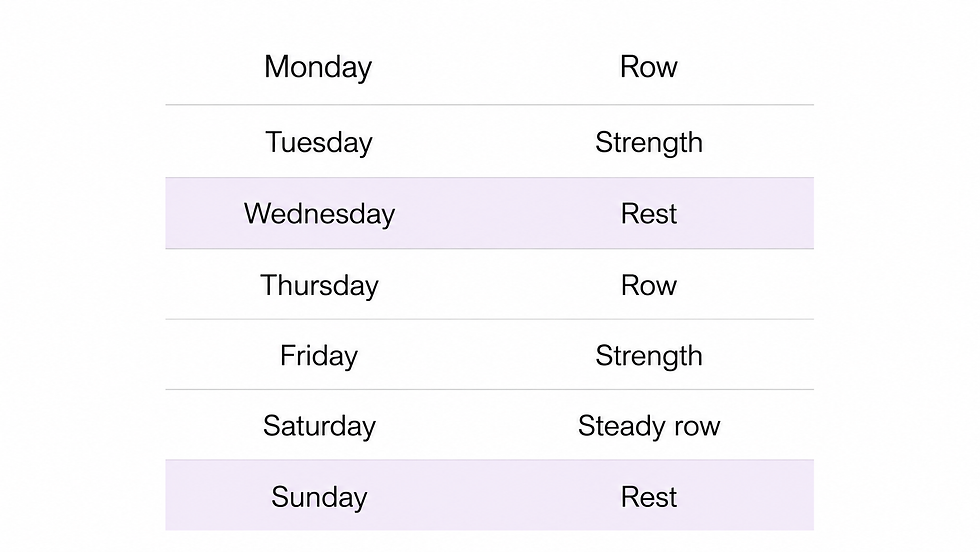
This is just one example. What matters isn't the particular days, but how the sessions are spaced.
The two harder rows are separated by several days, with a rest day before each. The strength sessions are around 72 hours apart, and neither comes immediately before a hard row. The steadier row follows a strength day, when some remaining fatigue is less likely to affect the quality of the session.
Your week may need to look different depending on when you can train. You might have fixed training sessions, limited access to a gym or particular days you want to keep free. The important thing is finding a structure that works with your schedule while allowing enough time for recovery.
Can You Row and Strength Train on the Same Day?
Yes. Sometimes combining sessions can make your week easier to manage. Training twice on one day can free up another day for complete rest, rather than spreading your training across most of the week.
However, I wouldn't combine two demanding sessions. If you need to row and lift on the same day, I'm much happier pairing a strength session with a steadier row than a hard row. For example, you might lift earlier in the day and complete a lower-intensity UT2 row later. A moderate-effort UT1 row can also work, depending on the intensity of the strength session and how you respond to it.
Leave several hours between the two sessions so you have time to recover, eat and rehydrate. British Rowing recommends allowing at least eight hours between strength and endurance sessions where possible.
Are You Doing Too Much?
More training isn't always better. Adding sessions only helps if you're able to recover from them and still perform your key sessions well.
Elite rowers often train several times per day and at much higher overall volumes. But most people can't devote that much time to training and recovery, so they need to be selective about how they use the sessions they do have.
One difficult session doesn't necessarily mean you're doing too much. Everyone has days when they feel tired or don't perform as well as expected. Instead, look for patterns.
You may need to reconsider your training week if you repeatedly notice:
Rowing paces getting slower at a similar level of effort
Missing reps or struggling with weights you would normally manage
Unusually heavy or unresponsive legs
Soreness that carries into your next few sessions
Disrupted sleep or a noticeable drop in motivation to train
If several of these are happening consistently, you may need to move a session, reduce the intensity or volume of your training, or add another rest day.
Start With the Sessions That Matter Most
When you're planning your week, start with the sessions that matter most and build the rest of your training around them.
If you also row on the water, include those sessions when planning your week. A demanding water session can create similar fatigue to a hard erg session, while easier technical or aerobic sessions require less recovery.
Need Help Structuring Your Training?
If you want a ready-made training plan for your rowing, explore my Downloadable Plans.
If you need more individual help balancing rowing and strength training, my Custom Programmes include both rowing-only and combined rowing + strength options.
If you enjoyed reading this article and would like to be notified about new articles and training insights, you can sign up to my free monthly newsletter.


